DWG NO. 1.1 — Lesson 1 of 6
Functions, Domain, and Range
Unit 1: Functions and Their Graphs · ~20 min
What makes a relation a function
A relation is just any pairing of inputs and outputs. A function is a relation with one extra rule: every input produces exactly one output. Nothing stops two different inputs from sharing the same output — that's allowed. What's not allowed is one input leading to two different outputs.
On a graph, this becomes the vertical line test: if any vertical line crosses the graph more than once, it's not a function, because that would mean one x-value maps to more than one y-value.
Domain and range
The domain of a function is the complete set of inputs (x-values) it accepts. The range is the complete set of outputs (y-values) it actually produces. Both are usually written in interval notation.
- Watch for zero in a denominator. Any x-value that makes the denominator 0 must be excluded from the domain.
- Watch for negatives under an even root. For an even index (square root, fourth root, …), the expression underneath must be ≥ 0.
- Everything else is usually all real numbers. Polynomials, for instance, accept any real input.
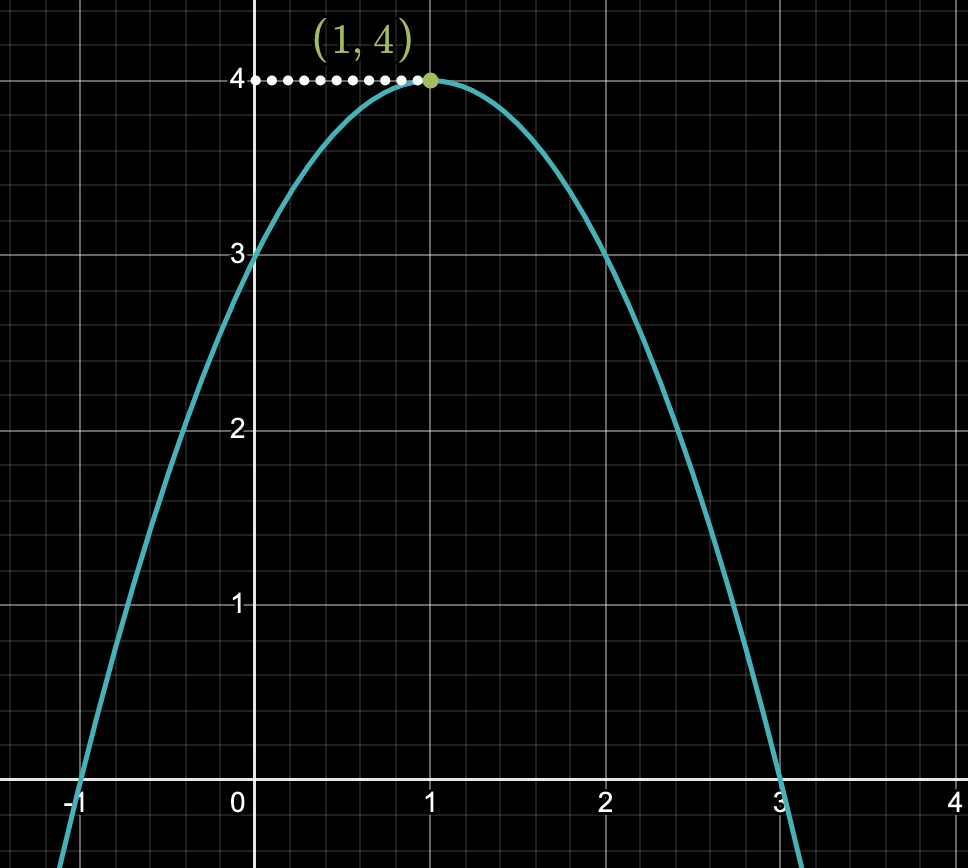
f(x) = −(x−1)² + 4 — domain: all real numbers; range: y ≤ 4
Guided practice
-
1.Is the relation {(1, 2), (2, 4), (1, 5), (3, 6)} a function? Explain why or why not.
Show answer
No. The input 1 appears twice, paired with two different outputs (2 and 5). That violates the one-output-per-input rule, so this relation is not a function. -
2.Find the domain of f(x) = \(\sqrt{5-x}\).
Show answer
Need 5−x ≥ 0, so x ≤ 5. Domain: (−∞, 5] -
3.Find the domain of g(x) = \(\frac{x+1}{x^{2}-9}\).
Show answer
Factor the denominator: x²−9 = (x−3)(x+3), which is 0 when x = 3 or x = −3. Domain: (−∞, −3) ∪ (−3, 3) ∪ (3, ∞) -
4.A function's graph is a single unbroken curve that starts at (−2, 0), rises to a peak at (0, 5), and comes back down to (2, 0), going no further left or right. State its domain and range.
Show answer
The curve only exists between x = −2 and x = 2, and only reaches as high as y = 5, never dropping below y = 0. Domain: [−2, 2] · Range: [0, 5] -
5.Use the vertical line test to explain why the graph of x = y² (a sideways parabola) is not a function of x.
Show answer
For any positive x-value, a vertical line crosses the sideways parabola twice — once at y = \(\sqrt{x}\) and once at y = −\(\sqrt{x}\). Two outputs for one input means it fails the vertical line test, so x = y² is not a function of x.